



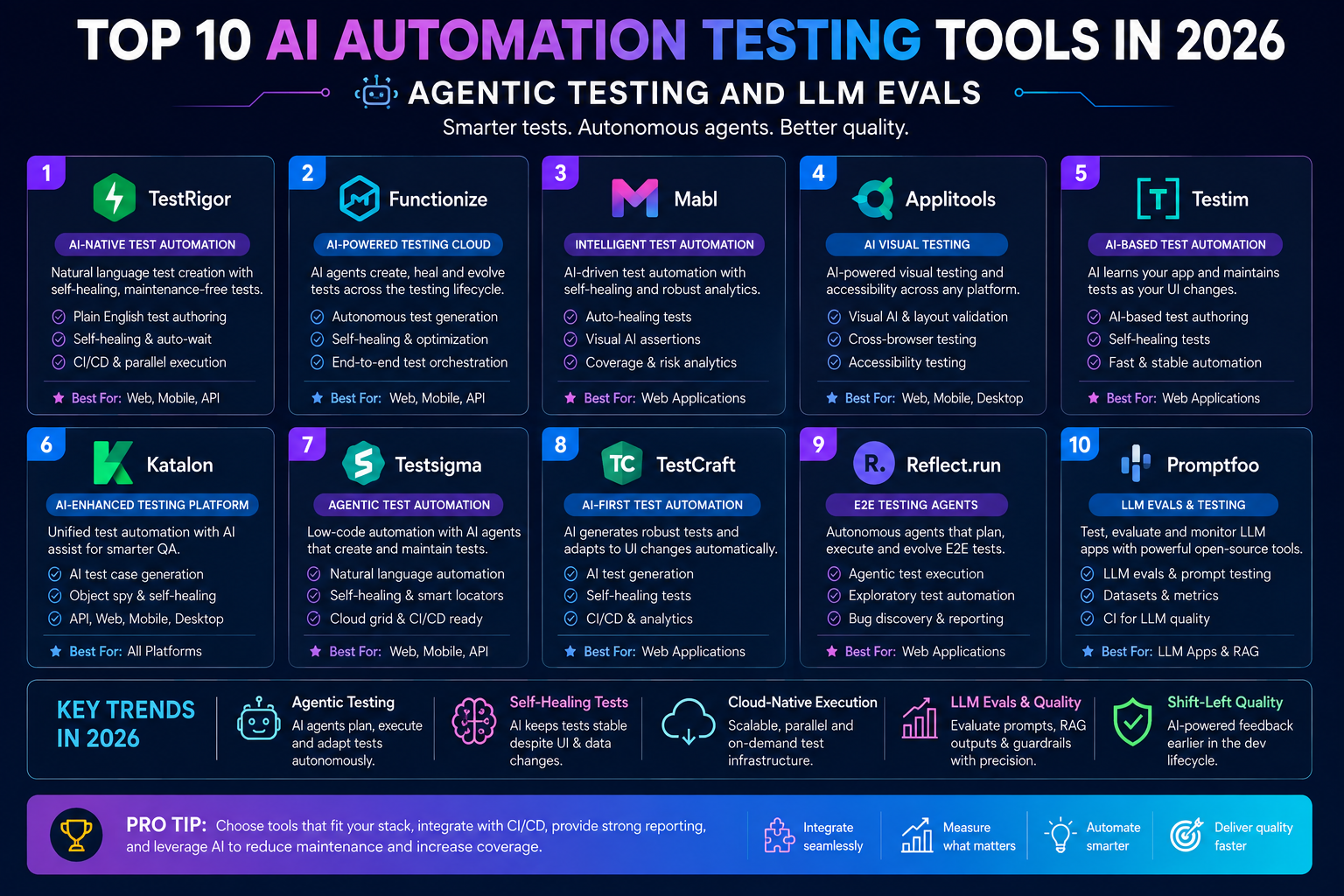
2024's AI Testing tools autocompleted selectors. 2026's tools write whole suites, evaluate LLM outputs against golden datasets, and validate AI agents with other AI agents. We covered the first generation, Testim, Mabl, Functionize and friends, in our earlier AI tools guide; this list is the new wave: the agentic and evaluation tooling that decides whether your AI feature ships measured or ships hoped-for.
The tools that deliver real ROI fall into four categories: autonomous test generation, agentic runtime execution, LLM/agent evaluation, and AI layered onto existing frameworks. Here are the ten worth your evaluation time, category by category.
Key Takeaways
- Coding agents (Claude Code, GitHub Copilot) are the most-used AI Testing tools of 2026, authoring cost has collapsed, and assertion review is the new bottleneck.
- promptfoo + DeepEval + Ragas form a free, open-source eval stack that puts prompt, output, and retrieval quality into CI as build gates.
- Agentic platforms (Mabl, Applitools Autonomous, TestMu AI) cut maintenance dramatically, at the price of framework ownership; negotiate exportable artifacts.
- Research warning: agent-written test volume shows no effect on outcomes. Golden datasets and meaningful assertions still decide everything.
How we evaluated (and what we ignored)
Every tool on this list has been used hands-on in QA Tech Xperts client engagements or evaluated against our AI Quality Engineering checklist during audits. No sponsored placements, no affiliate links. We scored six things:
- CI fit: can it gate a merge today, with diffable output a reviewer can act on?
- Maintenance cost: what breaks when the app, prompt, or model changes, and who fixes it?
- Ownership and exit: what do you keep if you stop paying, code, datasets, baselines?
- Signal quality: do its metrics correlate with failures your users would actually notice?
- Docs and community: can a mid-level Engineer be productive in a week without vendor hand-holding?
- Pricing transparency: we down-ranked tools where the real cost only appears on a sales call.
The 2026 AI Testing landscape at a glance
Ten tools, four jobs. Use this table to find your entry point, then read the writeups for the honest trade-offs:
| Tool | Category | Best for | Pricing | CI-native |
|---|---|---|---|---|
| Coding agents (Claude Code, Copilot) | Test authoring | Drafting and migrating suites | Subscription | Yes (headless) |
| promptfoo | LLM evals | Prompt regression gates | Free / OSS | Yes |
| LangSmith | Agent observability | Tracing agent behavior | Free tier + paid | Yes |
| DeepEval | LLM evals | Output metrics as pytest checks | Free / OSS (+ cloud) | Yes |
| Ragas | RAG evals | Retrieval-quality scoring | Free / OSS | Yes |
| Applitools Autonomous | Visual + agentic | UI-change-heavy apps | Commercial | Yes |
| Mabl | Autonomous Testing | Teams without dedicated SDETs | Commercial | Yes |
| TestRigor | Plain-English Testing | Manual-QA teams going automated | Commercial | Yes |
| TestMu AI | Agentic platform | Consolidated cloud + AI validation | Commercial | Yes |
| Maestro | Mobile + AI assists | React Native / Flutter smoke suites | Free / OSS | Yes |
1. LLM coding agents (Claude Code, GitHub Copilot), the biggest shift nobody lists
The most-used AI Testing tool of 2026 isn't a Testing tool: it's the coding agent sitting in your terminal. Agents like Claude Code and Copilot now scaffold Playwright suites from a URL and a prompt, port Selenium tests, and diagnose flake from trace files. Test authoring cost has collapsed; the skill that matters now is reviewing agent-written tests for assertion quality.
Wins: authoring speed, migrations, one-off harness code. Loses: judgment, agents happily write tests that assert nothing meaningful. Pair them with a human who knows what a good assertion looks like.
Field notes: in our own engagements, agent-drafted Playwright suites cut authoring time by more than half, and every one of them still needed a Senior pass to replace vanity assertions ('page loaded') with meaningful ones ('order total matches the cart').
2. promptfoo, LLM evals that live in CI
Open source, CLI-first, config-as-code: promptfoo is the most accessible way to make prompt changes fail a build. Define test cases in YAML, assert on content, similarity, or an LLM judge, and wire it into GitHub Actions like any other suite:
# promptfooconfig.yaml
prompts:
 - "Summarize this support ticket: {{ticket}}"
providers:
 - anthropic:messages:claude-sonnet-5
tests:
 - vars:
 ticket: "Refund not received after 14 days"
 assert:
 - type: contains
 value: "refund"
 - type: llm-rubric
 value: "Does not promise a specific refund date"
Wins: prompt regression on every merge, provider comparisons, red-teaming plugins. Loses: deep agent tracing, pair it with an observability layer. This is the tool we reach for first in AI quality audits. Field notes: the official GitHub Action posts eval diffs directly on pull requests, which is what finally gets prompt changes reviewed like code instead of merged on vibes.
3. LangSmith, see what your agent actually did
From the LangChain team, LangSmith is the tracing and evaluation layer for agentic systems: every step, tool call, and token logged, with datasets and evaluators attached to real production traces. When an agent completes nine steps and silently fails the tenth, this is where you find out which step lied.
Wins: agent debugging, production trace-to-dataset loops, team visibility. Loses: framework neutrality, it's best inside the LangChain orbit. Pick it when your agent's failure modes are invisible in logs.
Field notes: the pattern that pays is trace-to-dataset, every weird production trace becomes tomorrow's regression case in two clicks, so your eval set grows from reality instead of imagination.
4. DeepEval, unit tests for LLM outputs
DeepEval (Confident AI) brings pytest ergonomics to LLM evaluation: metrics for answer relevancy, faithfulness, hallucination, and toxicity as importable assertions. If your team already lives in pytest, this is the lowest-friction path to measured AI quality:
from deepeval import assert_test
from deepeval.metrics import FaithfulnessMetric
from deepeval.test_case import LLMTestCase

def test_refund_answer_is_grounded():
 case = LLMTestCase(
 input="What is your refund window?",
 actual_output=answer, # from your RAG pipeline
 retrieval_context=retrieved, # the chunks it used
 )
 assert_test(case, [FaithfulnessMetric(threshold=0.8)])
Wins: pytest-native ergonomics, a broad research-backed metric library, easy CI adoption. Loses: judge-model cost at scale, budget for eval tokens like you budget for CI minutes. Field notes: start with faithfulness and answer relevancy only; teams that switch on every metric at once drown in numbers nobody acts on.
5. Ragas, the RAG pipeline's report card
Ragas focuses on the metric set RAG teams actually need: context precision and recall, faithfulness, and answer relevancy, scored across your golden dataset so a reindex or embedding swap becomes a measured event instead of a vibe. We use it alongside recall@k checks in every RAG engagement.
Wins: retrieval-quality measurement, embedding/model comparisons. Loses: end-to-end UX judgment, it scores components, not customer happiness. Pick it the day your answers start citing the wrong policy.
Field notes: watch score distributions, not averages, a 0.9 mean faithfulness with a fat tail of 0.3s is a support-ticket generator hiding inside a healthy-looking dashboard.
6. Applitools Autonomous, visual AI goes agentic
The visual Testing leader now generates and maintains functional tests from plain-language intent, backed by the same Visual AI that made it famous. The bet: describe the journey, let the platform keep the script alive as the UI shifts.
Wins: visual-heavy apps, teams already on Eyes, low-maintenance coverage. Loses: complex conditional logic. Pick it where UI change velocity is what kills your suites.
Field notes: pair the Ultrafast Grid with a browser matrix ranked from your own analytics, paying to render combinations nobody uses is the classic first-month mistake.
7. Mabl, autonomous test generation, grown up
Mabl's agentic direction turns low-code into no-script: auto-generated journeys, self-healing selectors, API and accessibility checks in one platform, with genuinely useful failure diagnostics. One of the few first-wave tools that made the jump to the agentic era credibly.
Wins: agile teams without dedicated Automation Engineers, unified web/API/a11y coverage. Loses: fine-grained control and framework ownership. Pick it when speed-to-coverage beats owning the code.
Field notes: insist on exportable artifacts in the contract. The platform is genuinely good; your test intent still shouldn't be hostage to any vendor.
8. TestRigor, plain-English tests that executives can read
TestRigor executes tests written as English steps ('click cart', 'check that total is $42'), resolving elements the way a human describes them rather than by selector. In 2026 its generative features draft those steps from requirements.
Wins: manual-QA teams automating without code, tests as living documentation. Loses: edge-case precision. Pick it to convert a strong Manual-QA team into an Automation team this quarter.
Field notes: treat generated steps as drafts, the teams that succeed with plain-English Testing still review those steps with the same rigor as code.
9. TestMu AI, the agentic quality platform play
TestMu AI (formerly LambdaTest) has repositioned as a full-stack agentic Quality Engineering platform: autonomous agents that simulate real users at scale, plus purpose-built validation for AI agents themselves, agents validating agents. Early, ambitious, and worth watching if you need cloud scale and AI-feature validation in one contract.
Wins: breadth, device cloud plus agentic execution plus AI validation. Loses: maturity relative to focused tools. Pick it if consolidation matters more than best-of-breed.
Field notes: run a two-week pilot against your flakiest real flow before committing, agentic platforms differ wildly in how they handle authentication and test data, and the demo never shows you that.
10. Maestro, open-source mobile Testing with AI assists
Maestro made mobile E2E sane: YAML flows, built-in tolerance for flakiness and loading states, and AI-assisted flow generation, the open-source counterweight to heavyweight mobile platforms. For React Native and Flutter teams it's often the fastest path to trustworthy mobile smoke suites.
Wins: mobile-first startups, simple declarative flows, price (free). Loses: deep native edge cases versus XCUITest/Espresso. Pick it to get mobile coverage this sprint, not this quarter.
Field notes: Maestro's tolerance-first design, waits and retries built into every step, is why its suites survive React Native re-renders that break Appium scripts.
The trap: more agent-written tests ≠ better quality
A caution from recent research on AI-generated tests: test-writing volume shows no significant effect on task resolution rates. Agents can produce thousands of green checks that assert nothing. The discipline that matters is unchanged from the pre-AI era, golden datasets, meaningful assertions, adversarial cases, and a human who owns the definition of 'correct'. AI multiplies whichever discipline you already have, including zero.
How we stack them (our QEAP practice)
- Authoring: LLM coding agents draft Playwright/pytest suites; seniors review every assertion.
- Prompt regression: promptfoo in CI on every prompt or model change.
- RAG quality: Ragas + recall@k against a golden dataset on every reindex.
- LLM output checks: DeepEval faithfulness and hallucination metrics as build gates.
- Agent behavior: trace-level evaluation of tool calls and failure recovery, LangSmith-style.
- UI safety net: visual AI where rendering is revenue.
That stack is exactly what we deploy in our AI Quality Engineering engagements, the tools change yearly, the discipline doesn't. If your AI feature currently ships on 'it seemed fine in the demo', any three tools from this list will change your release conversations within a month.
FAQ: What are AI Automation Testing tools?
Tools that use machine learning and large language models to generate, execute, maintain, or evaluate software tests. In 2026 the category spans four jobs: writing tests (coding agents, Mabl, TestRigor), keeping them alive (self-healing platforms), evaluating AI systems themselves (promptfoo, DeepEval, Ragas, LangSmith), and validating what users actually see (Applitools).
FAQ: Do AI Testing tools replace QA Engineers?
No, they move the work up a level. Authoring and maintenance costs drop sharply, but every tool on this list still needs a human who defines correctness, reviews assertions, and owns the golden dataset. Teams that cut QA headcount after buying AI tooling consistently rediscover, in production, why the discipline existed.
FAQ: Which tool should an LLM-feature team adopt first?
promptfoo, in CI, this week. It's free, config-as-code, and turns your next prompt change into a measured event instead of a hopeful one. Add Ragas when retrieval quality becomes the question, and DeepEval when you want output metrics enforced as build gates.
Sources & further reading
- TestGuild, 12 Best AI Test Automation Tools: The Third Wave
- QA Wolf, The 12 Best AI Testing Tools in 2026
- Confident AI, Best LLM Evaluation Tools for AI Agents
- testomat.io, Top LLM Testing Frameworks & Tools for QA
- Plus hands-on use across QA Tech Xperts client engagements, no sponsored placements, no affiliate links.
Want us to run this on your product?
A free 30-minute assessment. We'll tell you what's working, what's costing you time, and where to start. Findings delivered within days.
Get a Free QA Assessment