



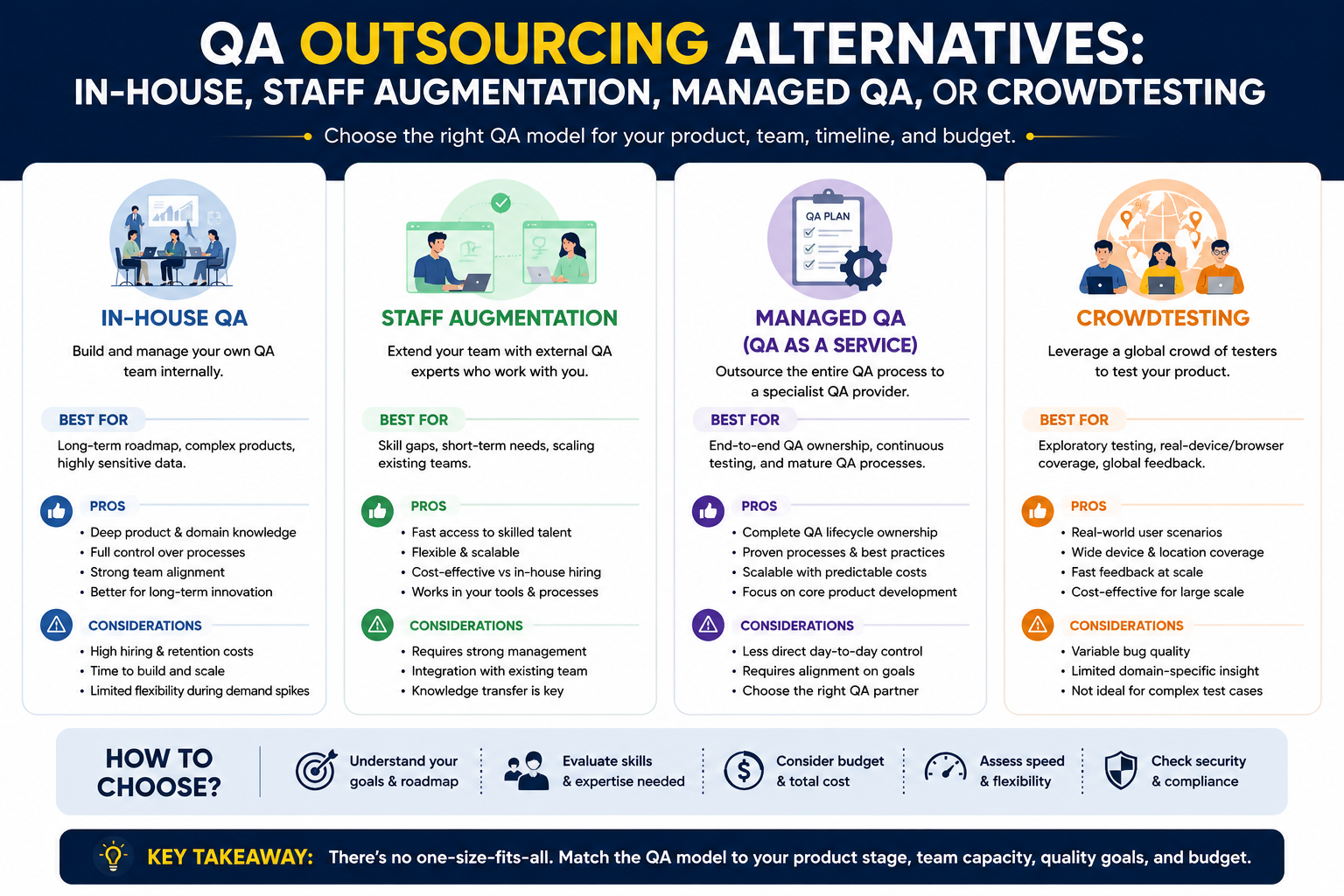
'Should we outsource QA?' is the wrong first question. There are five distinct models for getting software tested, they fail in different ways, and most teams end up combining two. Here's each one compared on what actually matters, cost structure, control, ramp time, and the specific failure mode you should expect, written by a company that provides three of the five and will tell you when the other two fit better.
Key Takeaways
- Five models: in-house hiring, staff augmentation, managed QA, crowdtesting, and automation-first tooling. Most mature teams run a hybrid.
- Cost per hour is the least predictive number. Ramp time, product-knowledge retention, and who owns the outcome decide the real cost.
- In-house wins on deep product knowledge; staff augmentation wins on speed and flexibility; managed QA wins when you want an outcome, not a resource.
- Crowdtesting is excellent for breadth (devices, geographies, fresh eyes) and poor for regression discipline, it complements, it doesn't replace.
The five models at a glance
| Model | Ramp time | Best for | Main risk |
|---|---|---|---|
| In-house hire | 6–12 weeks | Deep product knowledge, long horizon | Hiring risk, single point of failure |
| Staff augmentation | Days | Flexible capacity in your process | Needs an internal owner to direct |
| Managed QA | 1–3 weeks | Outcome ownership, full-cycle QA | Less day-to-day control |
| Crowdtesting | Days | Device/geography breadth, fresh eyes | No regression discipline or continuity |
| Automation-first tooling | Weeks | Repeatable regression at scale | Tooling without expertise creates debt |
1. Hiring in-house
The strongest long-term option when the economics work. An in-house QA Engineer accumulates product knowledge that no external party can match, sits in every conversation, and builds relationships that make quality a shared concern rather than a gate.
The costs people underestimate: six to twelve weeks to hire in a competitive market, a fully-loaded cost far above the salary line, ramp time before productivity, and concentration risk, one person leaving takes the institutional knowledge with them. It's also the hardest model to scale down if the roadmap changes.
- Choose it when: quality is a permanent core function, the roadmap is stable, and you can wait a quarter for productivity.
- Avoid it when: you need coverage this month, the workload is spiky, or you need a specialization (performance, AI evaluation, OTT) you'd use only part-time.
2. Staff augmentation
Dedicated Engineers who work inside your process, your stand-ups, your board, your definition of done, but are employed and supported by a partner. Ramp is days rather than months, you can scale up or down per quarter, and you get access to specializations you couldn't justify hiring full-time.
The honest failure mode: augmented Engineers are only as effective as the internal ownership directing them. Teams that hand over a login and expect strategy get task execution, not quality improvement. This model needs someone on your side who sets priorities.
- Choose it when: you need capacity or a specialization fast, and you have an internal owner to direct the work.
- Avoid it when: nobody internally has the time to prioritize, or the requirement is genuinely permanent and hire-able.
3. Managed QA services
You buy an outcome rather than people. The partner owns the test strategy, the suite, the reporting, and the number that matters, typically escaped defects per release. It's the lowest-management-overhead option and the one that most resembles a quality function you don't have to run.
The trade-off is control granularity. You're agreeing on outcomes and cadence, not directing daily work, which requires trusting the partner's judgment and demanding honest reporting including bad news. Get the reporting cadence into the contract, not the kickoff deck.
- Choose it when: you want quality owned end-to-end, and you'd rather review a weekly written status than run a team.
- Avoid it when: your product is so specialized that outcome definitions are impossible to agree, or you need hour-by-hour direction.
4. Crowdtesting
A distributed pool of testers exercising your product on their own devices, in their own countries, with genuinely fresh eyes. For breadth, a hundred real device/OS combinations, localization checks across markets, or usability impressions from people who've never seen your app, nothing else is as fast or as cheap.
What it structurally cannot provide: regression discipline, continuity of product knowledge, or an automated suite. Crowd testers report what they find; they don't build the systems that stop the same bug returning. Reports also need triage capacity on your side, or you drown in duplicates.
- Choose it when: you need device/geography breadth or pre-launch fresh eyes, and you have someone to triage the findings.
- Avoid it when: you need repeatable regression, deep domain understanding, or anything under NDA-sensitive constraints.
5. Automation-first tooling
Buy platforms, codeless Automation, AI test generation, self-healing suites, and have your existing team drive them. It's a genuine option in 2026 as tooling matured, and for teams with strong developers and simple, stable products it can substitute for headcount.
The trap is well documented: tooling amplifies whatever discipline you already have, including none. Teams that buy an AI Testing platform without anyone owning test design end up with thousands of generated assertions that pass while real bugs ship. The tool doesn't decide what 'correct' means.
- Choose it when: developers own quality, the product is stable, and someone owns test design even if it isn't their title.
- Avoid it when: nobody has bandwidth to curate the suite, you'll pay a license fee to accumulate technical debt.
How to decide in one pass
- Need coverage in days, keep control: staff augmentation.
- Need someone to own the quality outcome: managed QA.
- Need permanent deep product expertise and can wait a quarter: hire in-house.
- Need device or geographic breadth before a launch: crowdtesting, alongside something else.
- Need repeatable regression and have Engineers to run it: automation-first tooling with expert setup.
- Not sure: start with a fixed-scope assessment. The findings usually make the model obvious, and it costs a fraction of a wrong twelve-month commitment.
The hybrid most mature teams land on
In practice the durable pattern is two models, not one: an in-house QA lead who owns strategy and product knowledge, plus augmented specialists or a managed partner providing execution capacity and skills the lead doesn't have (performance, security, AI evaluation). Crowdtesting is layered in before major launches for breadth. That combination gives you continuity and elasticity at the same time, which no single model does alone.
FAQ: Is outsourced QA cheaper than hiring?
Usually on total cost, not always on hourly rate, and rate is the misleading number. Outsourcing removes recruitment cost, benefits, equipment, management overhead, and the risk of a bad hire, and it starts producing in days rather than months. But a cheap engagement staffed with juniors and no Senior review costs more in escaped defects and supervision time than a well-structured one. Compare outcomes per quarter, not rates per hour.
FAQ: Can we outsource QA without losing control?
Yes, and the mechanisms are contractual rather than cultural: named personnel, a weekly written status that includes bad news, your tools and repositories, IP assignment on everything produced, and an exit clause with handover obligations. Teams that lose control almost always skipped these in the SOW and tried to recover them in meetings.
FAQ: What's the lowest-risk way to try a QA partner?
A fixed-scope assessment or a single-engineer start. You see how the partner thinks, writes, and reports before any meaningful commitment, and the written findings are useful whether or not you continue. That's precisely why our entry point is a free assessment rather than a proposal, and the five questions in our buyer's guide filter out the weak options before you spend anything.
Want us to run this on your product?
A free 30-minute assessment. We'll tell you what's working, what's costing you time, and where to start. Findings delivered within days.
Get a Free QA Assessment