



Key Takeaways
- Five questions filter vendors fast: who does the work, what you own at exit, show me bad news, how do you test AI, can we start small.
- Price per hour is the least useful signal, Senior review and honest reporting are what you're actually buying.
- The lowest-risk entry is a fixed-scope assessment: findings in days, commitment optional.
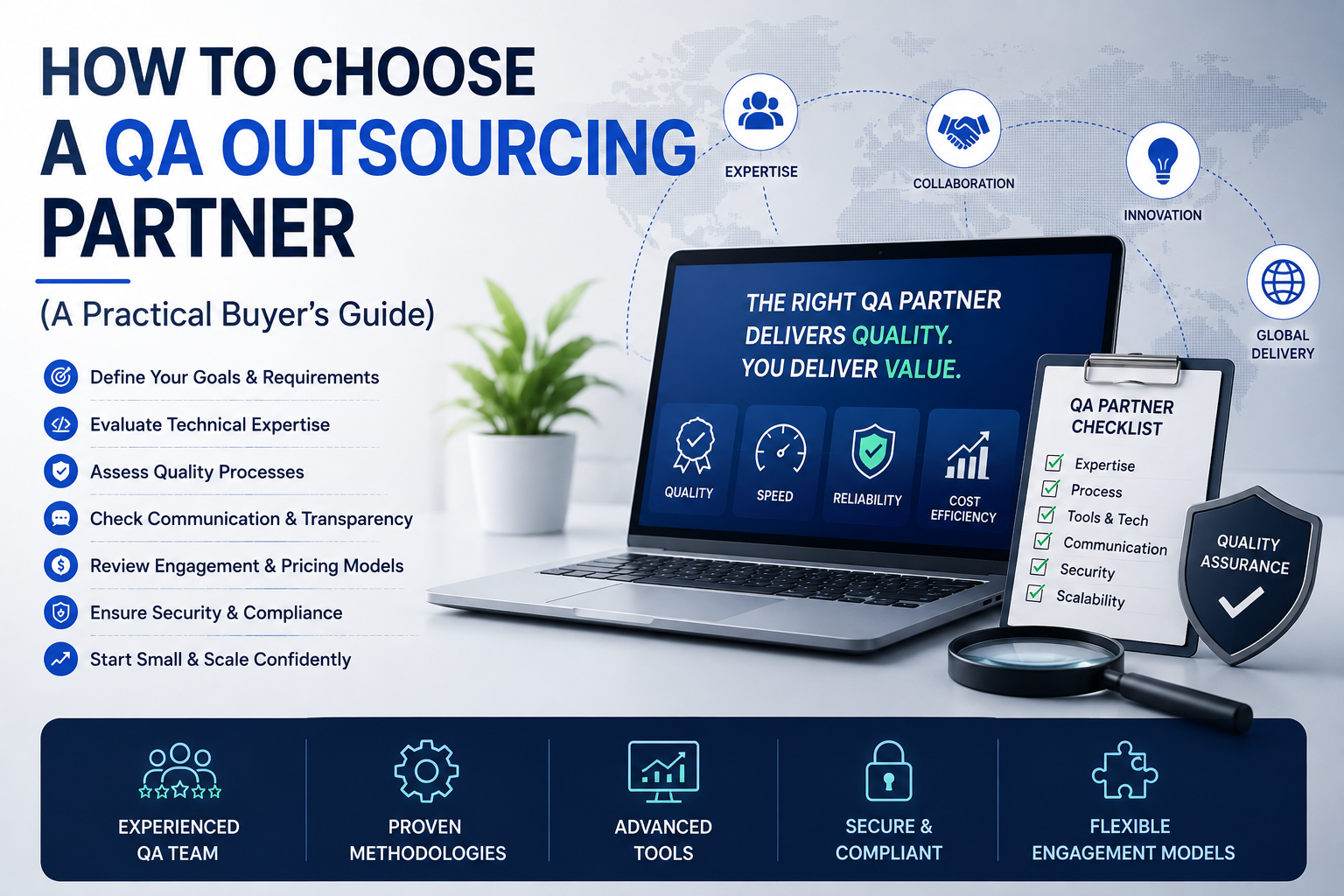
A QA outsourcing partner is chosen on five signals: who actually does the work, what you own when they leave, how they report bad news, whether they can test what's next (AI features), and how fast you can start small. Price per hour is the least useful metric when choosing a QA partner.
The five questions
- Who reviews the work? If Senior leadership isn't hands-on in your engagement, you're paying Senior rates for junior output
- What do we own at exit? Frameworks, docs, and eval harnesses should be handed over, a partner you can't leave is a long-term risk
- Show me a report where you delivered bad news. Honest reporting is the entire value of external QA
- How do you test AI features? Most vendors have a slide; ask for the evaluation harness
- Can we start with one Engineer or one audit? A partner confident in their work never needs a big-bang contract
Question 1: Who actually reviews the work?
Every vendor says 'Senior-led.' The test is specificity: ask for the name and calendar reality of the person who will review your deliverables. Green flag: a named practitioner with hours committed to your engagement. Red flag: 'our leadership oversees all projects', that's an org chart, not a commitment. If Senior review isn't in the engagement structure, you're paying Senior rates for junior output with a logo on it.
Question 2: What do we own at exit?
The frameworks, test data, documentation, and eval harnesses built on your engagement should be yours, in your repos, documented well enough to run without the vendor. Ask to see a handover package from a previous client (redacted is fine). A partner you can't leave isn't a partner; it's a dependency with an invoice. The strongest vendors make leaving easy precisely because that's why clients stay.
Question 3: Show me a report where you delivered bad news
Honest reporting is the entire value of external QA, you're buying eyes that don't answer to your release schedule. A real vendor has written 'this release is not ready, here's why' and can show it. If every sample report is green dashboards and celebration, the vendor is selling comfort, and comfort is the one thing QA must never sell.
Question 4: How do you test AI features?
This one filters fastest in 2026. Most vendors have a slide; ask for the artifact: an evaluation harness, a golden dataset structure, a prompt-regression setup they can walk through. Follow up with 'how do you measure retrieval accuracy?', a real practice answers with recall@k against a golden dataset in under a minute. A slide deck answers with adjectives.
Question 5: Can we start with one Engineer or one audit?
A partner confident in their work never needs a big-bang contract, they know the first month sells the next twelve. Insistence on large minimum commitments is a confession about churn. The healthiest commercial shape: a fixed-scope start, clear deliverables, and expansion that happens because you asked for it.
The scorecard
| Question | Green flag | Red flag |
|---|---|---|
| Who reviews the work? | Named Senior, hours committed | 'Leadership oversees everything' |
| What do we own at exit? | Repos, docs, harnesses, yours | Proprietary platform lock-in |
| Show me bad news | A real 'not ready to ship' report | Only green dashboards |
| How do you test AI? | Shows an eval harness, talks metrics | Shows a slide, talks vibes |
| Can we start small? | Fixed-scope entry, findings first | Big-bang contract or nothing |
Running the evaluation: a two-week bake-off
When two vendors survive the five questions, stop comparing proposals and start comparing work. Give both the same fixed-scope task on your real product, an audit of one module, or Automation of your three nastiest flows, paid, two weeks, same access. You're not scoring the deliverable alone; you're scoring the week-one questions they asked (good vendors interrogate your product; weak ones interrogate your template), the honesty of the findings (did anyone tell you something you didn't want to hear?), and the writing quality of the report, because that report is what you'll forward to your CTO every week for the next year. Two weeks of parallel evidence beats any reference call ever made.
Contract clauses that protect you later
- IP assignment on everything produced, frameworks, scripts, datasets, documentation, written into the MSA, not assumed.
- Named-personnel clause: the people you interviewed are the people on the engagement, with substitution requiring your approval.
- Handover obligations with teeth: documentation and transition support defined as deliverables, not favors, with a fixed exit-assistance period.
- Reporting cadence and honesty: a weekly written status including risks and bad news, specified in the SOW so it survives personnel changes.
- A 30-day off-ramp after the pilot: confidence is cheap to offer when the work is good; vendors who resist short exits are pricing in your regret.
The real cost of the cheap vendor
The rate difference between a $15/hour body shop and a Senior-reviewed practice looks decisive on a spreadsheet and evaporates in production. The cheap engagement costs you twice: once in the invoice, again in the escaped defects, the unreadable bug reports your Engineers must translate, and the suite you inherit that nobody trusts. Price the outcome, escaped defects per release, suite trust, time your Engineers spend supervising, and the spreadsheet flips.
The start-small pattern that works
The lowest-risk entry is a fixed-scope assessment: a 30-minute call, then written findings within days. You learn how the partner thinks before any commitment, and if the findings aren't sharp, you've lost nothing. That's exactly why we lead with a free one.
Want us to run this on your product?
A free 30-minute assessment. We'll tell you what's working, what's costing you time, and where to start. Findings delivered within days.
Get a Free QA Assessment