



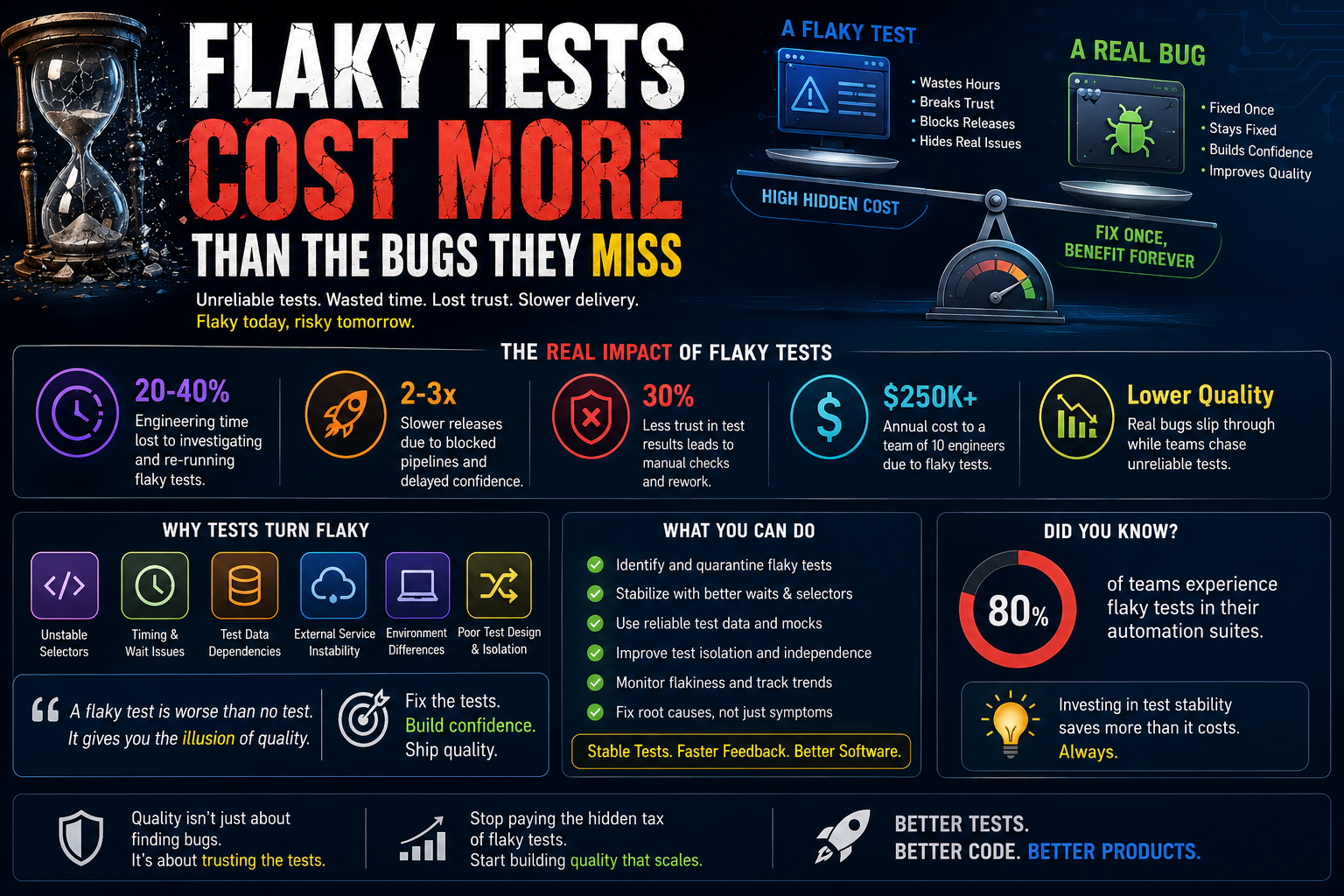
Key Takeaways
- A flaky suite converts your strongest quality signal, a red build, into noise everyone learns to ignore.
- The 30-day recovery: measure and tag, quarantine, fix the top offenders, then enforce with an auto-quarantine rule.
- Structure keeps it fixed: isolated data, API-first setup, explicit waits, and a visible flake budget.
A flaky suite costs more than a missing one, because it converts your strongest quality signal, a red build, into noise everyone learns to ignore. The day a real regression hides inside 'probably just flake' is the day the suite's ROI goes negative.
The 30-day recovery plan
- Week 1: measure, tag every failure as product bug, test bug, or infrastructure; you can't fix a mix you haven't split
- Week 2: quarantine, flaky tests move out of the gate automatically; the gate must mean something again
- Week 3: fix the top offenders, usually timing waits, shared state, and selector fragility, in that order
- Week 4: enforce, a new test that flakes twice gets auto-quarantined and assigned; flake-rate goes on the team dashboard
Why teams normalize red (the psychology of flake)
No team decides to ignore its test suite; it erodes. The first ignored flake is rational, a known-bad test, a re-run, ship it. The tenth is habit. By the fiftieth, 're-run until green' is documented in the onboarding guide and the suite's actual signal value is zero, while its cost, compute, wall-clock, maintenance, remains at 100%. The mechanism is social proof: every time a Senior Engineer re-runs without investigating, they teach every junior watching that red doesn't mean anything. That's why recovery plans that start with tooling fail, and plans that start with measurement work, you cannot re-normalize a signal until you can show, with numbers, which reds are real.
Week 1 in detail: the failure taxonomy
The measurement week is one spreadsheet and a rule: every red build gets tagged within an hour, by the person closest to it, into exactly one bucket, product bug (the test caught something real), test bug (selector, wait, data, or logic problem in the test itself), or infrastructure (runner died, environment down, dependency flaked). A week of honest tagging produces the two numbers that drive everything after: your true-positive rate (reds that were real, below 50% means your suite is currently an alarm nobody should trust) and your top-five flaky tests, which in every suite we've measured account for the majority of false reds. Fix five tests, halve the noise, that's week 3's entire justification.
Tooling that makes flake visible
- CI-native detection: GitLab and Jenkins flag tests that flip outcomes on retry; GitHub Actions gets there with report processing, free signal most teams never switch on.
- Retry-with-report, never silent retry: auto-retry that hides the first failure erases the data you need; retry and record both outcomes.
- Playwright/Cypress built-ins: retries with trace-on-retry give you a replayable recording of exactly the flaky run, which converts 'cannot reproduce' into a ten-minute fix.
- A flake dashboard: per-test failure rate over 30 days, on a screen people see, visibility alone changes behavior.
The real math of a flaky suite
Put numbers on it and the priority argues for itself. Take a team of eight Engineers with a suite that fails falsely twice a day: each red build costs a context switch, a re-run, and an 'is this real?' investigation, call it 40 minutes of Engineer time per event across the people it interrupts, already about 27 hours a month. Now add the slow releases: if one release a month waits half a day on 'let's just re-run it to be sure', that's another engineer-day gone. The silent cost is worse, the day a real regression hides inside the flake noise, you pay incident-response prices for a bug your suite technically caught.
- Direct cost: false failures × investigation time × Engineer rate, usually 20–40 hours/month for a mid-size team.
- Velocity cost: release delays while humans arbitrate what CI should have decided.
- Trust cost: every ignored red build raises the odds the next real one is ignored too, this is the one that ends up in a postmortem.
Quarantine mechanics, concretely
Quarantine only works when it's automatic and visible. The pattern: a tag that moves a test out of the merge gate but keeps it running and reporting, plus a standing rule that anything tagged for more than two weeks gets fixed or deleted:
// playwright: quarantined tests run, report, but don't block merges
test("transfer between accounts @quarantine", async ({ page }) => {
 // ...
});

// CI: gate on the stable suite, surface the quarantine suite
// npx playwright test --grep-invert @quarantine <- blocks merge
// npx playwright test --grep @quarantine <- reports only
Keep it fixed
Trusted suites stay trusted through structure: isolated test data, API-first setup, explicit waits on state (never sleeps), and a visible flake budget. If your team is past the point of self-rescue, a focused stabilization engagement is usually cheaper than another quarter of ignored builds.
Want us to run this on your product?
A free 30-minute assessment. We'll tell you what's working, what's costing you time, and where to start. Findings delivered within days.
Get a Free QA Assessment