



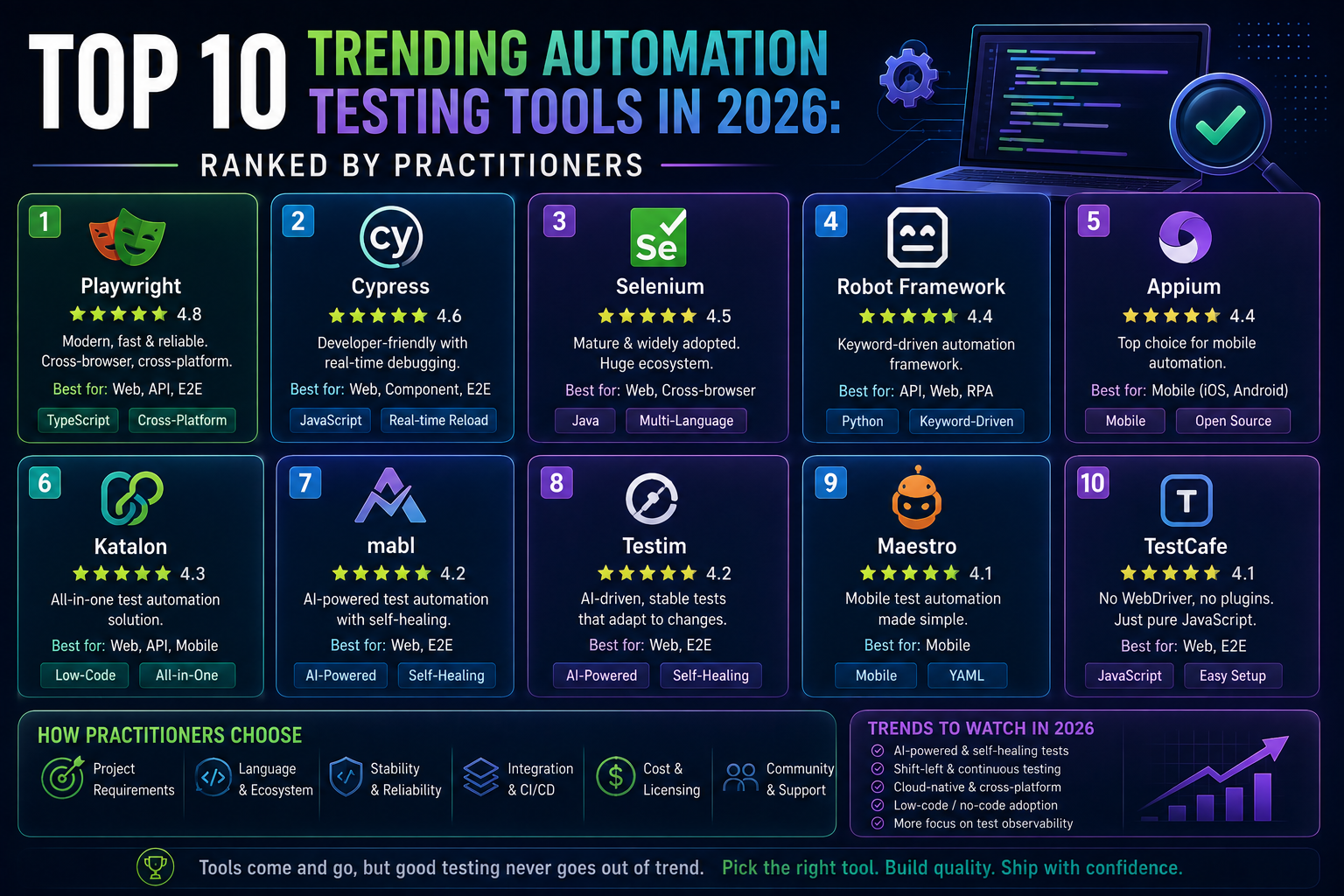
Tool lists are usually written by people who have never maintained a suite past month three. This one isn't. These are the ten Automation Testing tools we see earning their place in real pipelines in 2026, ranked from daily use across client engagements, not from vendor decks. The market context matters: industry analysts size Test Automation at roughly $20B today and project it to more than double by 2031, which means every tool below has a marketing budget. Ignore the noise; here's what actually holds up in CI at 2 a.m.
How to read this list
There is no 'best tool', there's a best tool for your app, your team's languages, and your CI. For each entry we give the honest verdict: where it wins, where it loses, and who should pick it. The ranking reflects momentum and breadth in 2026, not absolute quality.
Key Takeaways
- Playwright is the 2026 default for new web suites; a stable Selenium estate is usually better stabilized than rewritten.
- Match tools to your team's first language and your CI, maintenance cost, not authoring speed, decides long-term ROI.
- Cover the whole stack: API (Postman, Karate), performance (k6), visual (Applitools), and real devices (BrowserStack) each earn a slot.
- Run a two-week spike on your three nastiest real flows before committing, vendor demo apps prove nothing.
How we evaluated
Every ranking here comes from tools we run in client engagements, suites we build, stabilize, or inherit. No sponsored placements. Six criteria, weighted toward what costs money in year two, not what demos well in week one:
- Maintenance burden: what breaks on a UI change, a dependency bump, a new browser version?
- CI behavior: parallelism, retries, artifacts, and flake reporting out of the box.
- Team fit: does it meet your Engineers in a language they already ship in?
- Ecosystem depth: docs, community answers, hiring pool.
- Ownership: your tests, your data, your exit, or a subscription hostage situation.
- Total cost: licenses plus the engineering hours the tool quietly consumes.
The 2026 Automation landscape at a glance
| Tool | Type | Best for | Language / stack | License |
|---|---|---|---|---|
| Playwright | E2E web | New suites, modern SPAs | TS/JS, Python, Java.NET | Free / OSS |
| Selenium | E2E web | Enterprise estates, broad matrices | Java, Python, C#, Ruby, JS | Free / OSS |
| Cypress | E2E + component | JS-first product teams | JavaScript / TypeScript | OSS + paid cloud |
| Appium | Mobile E2E | Cross-platform iOS + Android | Any WebDriver language | Free / OSS |
| Postman | API | Team API workbench | Collections / JS | Free tier + paid |
| Karate | API | Readable BDD regression | Gherkin-style DSL / Java | Free / OSS |
| k6 | Performance | Load Testing in CI | JavaScript | OSS + Grafana Cloud |
| Applitools | Visual | Pixel-critical UIs | SDKs for major frameworks | Commercial |
| BrowserStack | Device cloud | Real-device matrices | Any framework | Commercial |
| Tricentis Tosca | Codeless enterprise | SAP / Salesforce estates | Model-based | Commercial |
1. Playwright, the 2026 default for web
Microsoft's framework has become the default for new web suites, and for concrete reasons: auto-waiting kills the biggest flake class by design, trace viewer turns 'works on my machine' into a replayable recording, parallel workers ship out of the box, and one API drives Chromium, Firefox, and WebKit. API Testing, network mocking, and storage-state auth are built in, no plugin roulette.
Wins: new suites, modern SPAs, TypeScript teams, CI speed. Loses: legacy browser coverage, non-JS-first teams who'd fight the ecosystem. Pick it when you're starting fresh in 2026, and for the full head-to-head, see our Playwright vs Selenium decision guide.
2. Selenium, the enterprise workhorse that won't die
Twenty years in, Selenium 4+ is W3C-native, Grid runs cleanly in Docker/Kubernetes, and no tool matches its language breadth (Java, Python, C#, Ruby, JS) or its grid maturity for very large cross-browser matrices. The 'Selenium is dead' takes are written by people who've never seen a 4,000-test enterprise estate.
Wins: existing investments, Java/C# organizations, huge browser matrices, vendor-neutral standards. Loses: out-of-the-box DX, you assemble waits, reporting, and parallelism yourself. Pick it when you have it and it's stable; stabilize, don't rewrite.
3. Cypress, the frontend developer's favorite
Cypress still owns the developer-experience crown for JavaScript-first teams: time-travel debugging, component Testing, and an in-browser runner developers genuinely enjoy. Its constraints (single-tab model, cross-origin flows that need cy.origin() ceremony, WebKit gaps) are real but irrelevant for many product architectures.
Wins: component tests, JS/TS product teams, fast local feedback. Loses: multi-tab flows, Safari coverage, heavy parallel CI without paid add-ons. Pick it when your frontend team owns quality.
4. Appium, mobile Automation's common denominator
For native and hybrid mobile apps, Appium remains the cross-platform standard: one WebDriver-style API across iOS (XCUITest) and Android (UiAutomator2/Espresso), with real-device cloud support everywhere. Appium 2's driver/plugin architecture cleaned up years of monolith pain.
Wins: cross-platform mobile coverage, reuse of Selenium skills, device clouds. Loses: speed and stability versus platform-native frameworks on single-platform apps. Pick it when you ship both iOS and Android and can't afford two suites.
5. Postman, where API Testing starts
Postman is how most teams' API Testing begins, and in 2026 it has grown into collection-based automated suites, contract checks, mock servers, and CI runs via Newman/Postman CLI. It is the shared language between developers, QA, and even product on what an API actually does.
Wins: exploratory API work, team collaboration, quick smoke suites in CI. Loses: complex data-driven suites, code-first tools scale better. Pick it as your API workbench; graduate the critical paths to code.
6. Karate, API Automation your whole team can read
Karate's Gherkin-style DSL makes automated API suites readable by non-programmers while staying powerful: JSON assertions, schema validation, data-driven scenarios, even performance Testing via Gatling integration, one tool, one syntax.
Wins: BDD-style API regression, contract checks, teams mixing technical levels. Loses: very custom logic, you'll drop into JS/Java escapes. Pick it for service-layer regression that outlives individual Engineers.
7. k6, performance Testing as code
Grafana's k6 made load Testing something developers actually run: JavaScript scripts, tiny resource footprint, CI-native, with thresholds that fail builds when p95 latency drifts. Paired with Grafana dashboards it turns performance from a launch-week panic into a merge-time check.
Wins: developer-centric load tests, CI performance baselines, cloud or self-hosted at scale. Loses: complex protocol mixes and GUI-driven test design, that's JMeter country. Pick it to make performance a habit, not an event.
8. Applitools, visual Testing that understands UIs
Applitools' Visual AI compares what users see, not what the DOM claims, catching layout breaks, rendering regressions, and cross-browser drift that functional asserts sail past. Its Ultrafast Grid renders one test across dozens of browser/viewport combinations in minutes.
Wins: visual regression at scale, brand-critical UIs, cross-browser rendering confidence. Loses: teams that haven't stabilized functional flake first, visual noise amplifies it. Pick it when pixels are revenue (E-commerce, fintech, design systems).
9. BrowserStack, the device matrix you don't have to own
Real devices, real browsers, thousands of combinations, zero lab maintenance. BrowserStack is how teams run Playwright, Selenium, Appium, and Manual sessions across the matrix their analytics say actually matters, including the old-OS devices that break first.
Wins: instant real-device coverage, legacy browser access, parallel cloud execution. Loses: cost discipline, unbounded matrices burn budgets; rank by audience share first. Pick it once you know which twenty combinations cover 95% of your users.
10. Tricentis Tosca, enterprise Automation without code
In large enterprises where SAP, Salesforce, mainframes, and web apps share one release train, Tosca's model-based, codeless approach and risk-based optimization still lead. Its Vision AI drives UIs that expose no clean selectors at all.
Wins: packaged-app estates, mixed-skill QA organizations, compliance-heavy programs. Loses: price, agility, and developer culture fit, product startups will hate it. Pick it when your landscape looks like a Fortune 500's, because if it does, you probably are one.
A selection framework that outlives any list
- Match the tool to your team's first language, a 'better' tool nobody can extend is a worse tool.
- Weight maintenance over authoring: the cost of a suite is 20% writing, 80% keeping it trusted.
- Demand CI-native behavior: parallelism, retries, artifacts, and flake reporting out of the box.
- Run a two-week spike on your three nastiest real flows, not the vendor's demo app.
- Check the exit: what do you own if you leave? Frameworks and data should be yours.
Our default stack, for the record
New web suite: Playwright + TypeScript. Existing estate: stabilized Selenium. Mobile: Appium on a ranked BrowserStack matrix. APIs: Postman for the workbench, Karate for regression. Performance: k6 with CI thresholds. Visual: Applitools where pixels pay the bills. The framework matters less than the architecture around it, selector contracts, data isolation, and CI discipline decide whether any of these ten still works for you in a year. If you'd rather have that architecture built for you, that's our Automation Testing practice.
FAQ: Which Automation Testing tool is best in 2026?
For most teams starting fresh on a modern web app: Playwright with TypeScript. But 'best' is a property of your situation, not the tool, a Java shop with a stable Selenium estate, a JS team deep in Cypress, or an SAP-heavy enterprise on Tosca would each be wrong to switch just because a list said so.
FAQ: Is Selenium still worth learning in 2026?
Yes. The largest install base in the industry, the deepest enterprise demand, and Selenium 4's W3C-native architecture keep it commercially relevant. Engineers who know both Selenium and Playwright, and when each fits, are more valuable than partisans of either.
FAQ: How many of these tools does one team actually need?
Three to five, covering distinct layers: one UI framework, one API tool, one performance tool, plus visual and device coverage where the product justifies it. Ten tools in one pipeline is not a stack, it's a maintenance bill.
Sources & further reading
- TestGuild, Best AI Test Automation Tools: The Third Wave
- Katalon, Best Automation Testing Tools for 2026
- ACCELQ, Top 12 Test Automation Tools Compared
- HeadSpin, 20 Best Automation Testing Tools
- Plus daily use across QA Tech Xperts client suites, the rankings reflect what survives year two, not week one.
Want us to run this on your product?
A free 30-minute assessment. We'll tell you what's working, what's costing you time, and where to start. Findings delivered within days.
Get a Free QA Assessment