



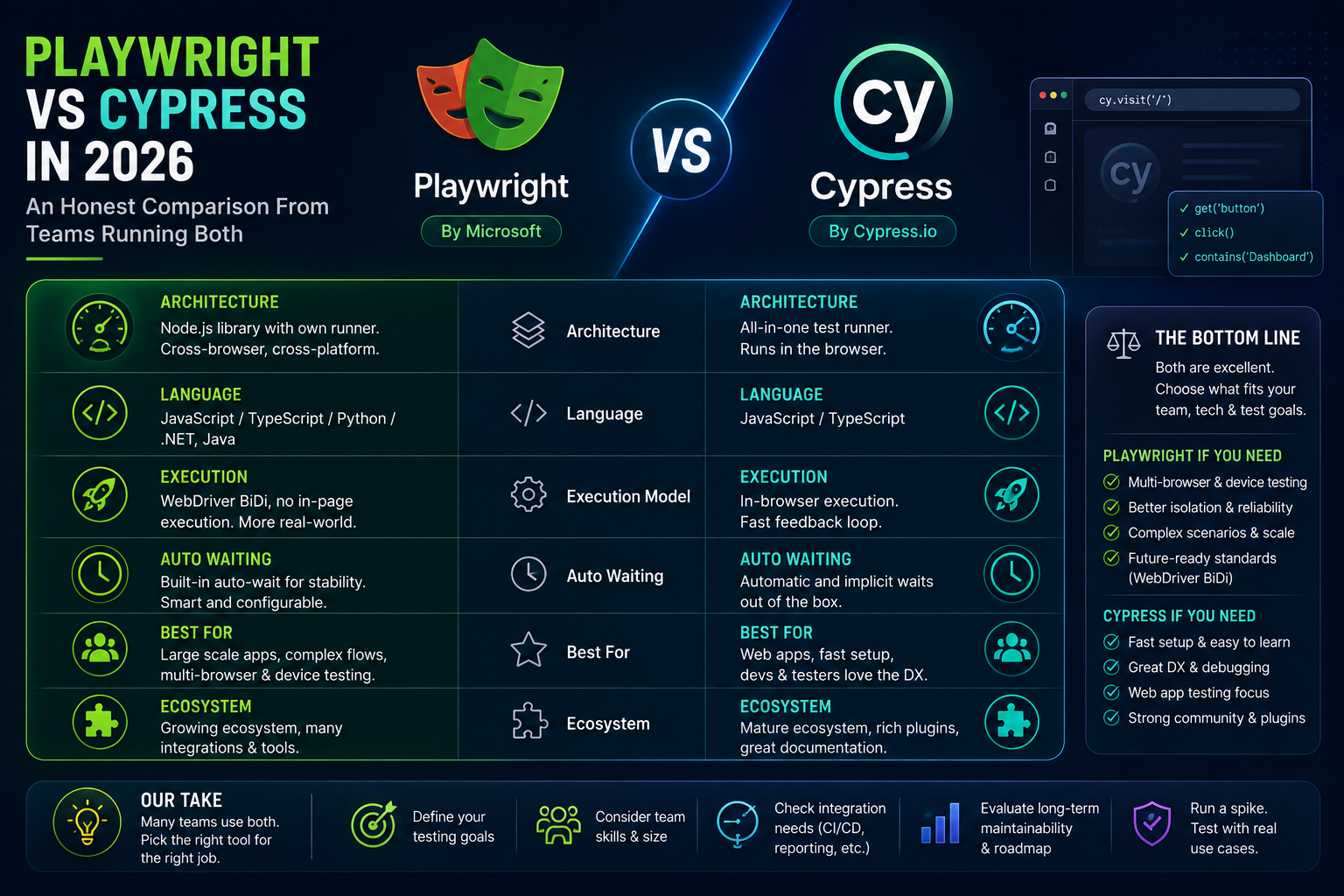
Playwright and Cypress are both excellent, actively developed, and capable of carrying a serious regression suite. The question worth answering isn't which is 'better', it's which architecture fits your application, your team's language, and the CI budget you actually have. We build and maintain suites in both across client engagements, and the honest answer changes depending on four specific things.
Key Takeaways
- Playwright fits most new suites in 2026: multi-browser including WebKit, true parallelism, multi-tab and multi-origin flows, and no per-machine license cost for parallel CI.
- Cypress still wins on developer experience and component Testing, for JS-first product teams whose app is single-origin, it's a legitimate choice, not a legacy one.
- The architectural divide: Cypress runs inside the browser, Playwright drives it from outside. Nearly every practical difference follows from that one fact.
- Don't migrate a healthy Cypress suite for fashion. Migrate when you hit its architectural limits, Safari coverage, multi-tab, or parallel CI economics.
The architectural difference everything else follows from
Cypress executes your test code inside the browser, in the same event loop as your application. That's the source of its best feature, the interactive runner with time-travel debugging, where you can inspect the app's exact state at every command, and also the source of its constraints: same-origin restrictions, no true multi-tab, and a harder path to browsers it can't instrument that way.
Playwright drives browsers from outside via their debugging protocols. That's why it can control multiple tabs, multiple origins, and multiple browser contexts in one test, run WebKit on any OS, and intercept the network at a level Cypress can't reach. The trade-off is that debugging is post-hoc (an excellent trace you replay) rather than live-in-the-browser.
Neither model is superior in the abstract. But if you know which constraints your product's flows impose, the choice usually makes itself.
Head to head, 2026
| Dimension | Playwright | Cypress |
|---|---|---|
| Browser coverage | Chromium, Firefox, WebKit (Safari engine) | Chromium family, Firefox, WebKit (experimental) |
| Execution model | Drives browser externally | Runs inside the browser |
| Multi-tab / multi-origin | Native support | Limited; cy.origin() for cross-origin |
| Parallelism | Built-in workers + sharding, free | Parallelization via Cypress Cloud (paid) or self-managed |
| Debugging | Trace viewer: replayable recording | Interactive runner: live time-travel |
| Component Testing | Supported | Excellent, a core strength |
| Languages | TS/JS, Python, Java.NET | JavaScript / TypeScript only |
| Auto-waiting | Yes, on actions and assertions | Yes, built into command chain |
| Network control | Full interception, HAR replay | cy.intercept(), strong but in-browser |
| Best fit | New suites, cross-browser, complex flows | JS teams, component tests, single-origin apps |
Where Playwright wins decisively
- Safari/WebKit coverage on any OS, if your analytics show meaningful Safari traffic, this alone often decides it.
- Flows crossing tabs or origins: OAuth redirects, payment providers, admin-opens-new-tab journeys.
- CI economics at scale: workers and sharding are free and built in, so cutting a 40-minute suite to 10 costs engineering time, not license fees.
- Polyglot teams: a Python or .NET shop can write Playwright in their own language rather than staffing a JS island.
- Trace-based debugging of CI-only failures, the trace makes 'cannot reproduce locally' a solved problem.
Where Cypress still wins
- Component Testing: mounting React/Vue/Angular components and exercising them in a real browser is where Cypress remains genuinely excellent.
- The inner Development loop: the interactive runner watching tests re-run as you edit is a productivity experience Playwright's UI mode approaches but many developers still prefer.
- Team adoption in JS-first orgs: frontend developers who already live in the JS ecosystem tend to write and maintain Cypress tests voluntarily, which matters more than any feature list.
- Mature, opinionated defaults: less architectural decision-making required up front, which suits smaller teams without a dedicated Automation Engineer.
The same test, both ways
The APIs are more similar than partisans admit. Cypress chains commands; Playwright awaits locators. Both auto-wait, and neither needs a sleep:
// Cypress
describe("checkout", () => {
 it("completes an order", () => {
 cy.visit("/cart");
 cy.findByRole("button", { name: /checkout/i }).click();
 cy.findByLabelText("Card number").type("4242424242424242");
 cy.findByRole("button", { name: /pay/i }).click();
 cy.contains("Order confirmed").should("be.visible");
 });
});

// Playwright
test("completes an order", async ({ page }) => {
 await page.goto("/cart");
 await page.getByRole("button", { name: /checkout/i }).click();
 await page.getByLabel("Card number").fill("4242424242424242");
 await page.getByRole("button", { name: /pay/i }).click();
 await expect(page.getByText("Order confirmed")).toBeVisible();
});
The CI cost conversation nobody has early enough
Suite speed is the cost line that surprises teams in year two. Both frameworks are fast per test; the difference is how you buy parallelism. Playwright's workers and shard flag are part of the open-source framework, you scale by adding CI machines you already pay for. Cypress's official parallelization and test-splitting run through Cypress Cloud, a paid product (self-managed alternatives exist and add maintenance).
For a small suite this is noise. For a suite of several hundred tests running on every merge across a team of twenty, it becomes a real line item worth modeling before you commit rather than after.
Hiring and the talent pool
Both have healthy communities. Cypress has years of accumulated tutorials and a large base of frontend developers who've used it. Playwright's momentum among Automation specialists is currently stronger, and its multi-language support widens the hiring pool beyond JavaScript Engineers, a Java-shop QA lead can be productive without a language switch. If you're staffing a dedicated Automation function, Playwright's pool is broader; if your frontend developers will own the tests, Cypress meets them where they already are.
Our recommendation, stated plainly
New suite, modern web app, no constraints: Playwright with TypeScript. It's the safer default in 2026 because its architectural ceiling is higher, you're unlikely to hit a wall that forces a migration later.
Existing healthy Cypress suite: keep it and invest in stabilization. Rewrites consume a quarter and produce, at best, the coverage you already had. Migrate when you hit a real architectural limit, Safari coverage you can't fake, multi-tab flows you can't test, or parallel CI costs that stopped making sense.
Mixed reality is fine too: several clients run Cypress component tests alongside Playwright E2E, which plays to each tool's strength. That's not indecision, it's using the right instrument per layer.
FAQ: Is Cypress dying?
No. It's actively developed, widely deployed, and still the best-in-class option for component Testing and developer-owned frontend quality. What changed is that Playwright became the default recommendation for new cross-browser E2E suites, which is a shift in where each tool is strongest, not an obituary. Treat 'X is dead' takes as a signal about the writer, not the tool.
FAQ: How long does a Cypress-to-Playwright migration take?
Budget roughly one engineer-day per ten stable tests, doubling for tests with heavy custom commands or bespoke waits. The safe pattern is side-by-side: rebuild the ten highest-value flows first and gate releases on both suites, write all new tests in Playwright only, and retire Cypress area by area once the Playwright suite has caught a real regression in each. A 400-test suite typically reaches critical-path parity in a quarter.
FAQ: Which is better for a small startup team?
Whichever your Engineers will actually maintain. If your two frontend developers own quality and your app is single-origin, Cypress's developer experience may produce more real coverage than a 'better' tool nobody enjoys. If you're hiring a QA Engineer or need Safari coverage, start on Playwright. The failure mode at startup scale is never the tool, it's the suite nobody owns.
If you want a second opinion on which fits your stack, or a suite stabilized rather than replaced, that assessment is exactly what our Automation Testing practice does, and the Playwright vs Selenium guide covers the other half of this decision.
Want us to run this on your product?
A free 30-minute assessment. We'll tell you what's working, what's costing you time, and where to start. Findings delivered within days.
Get a Free QA Assessment