



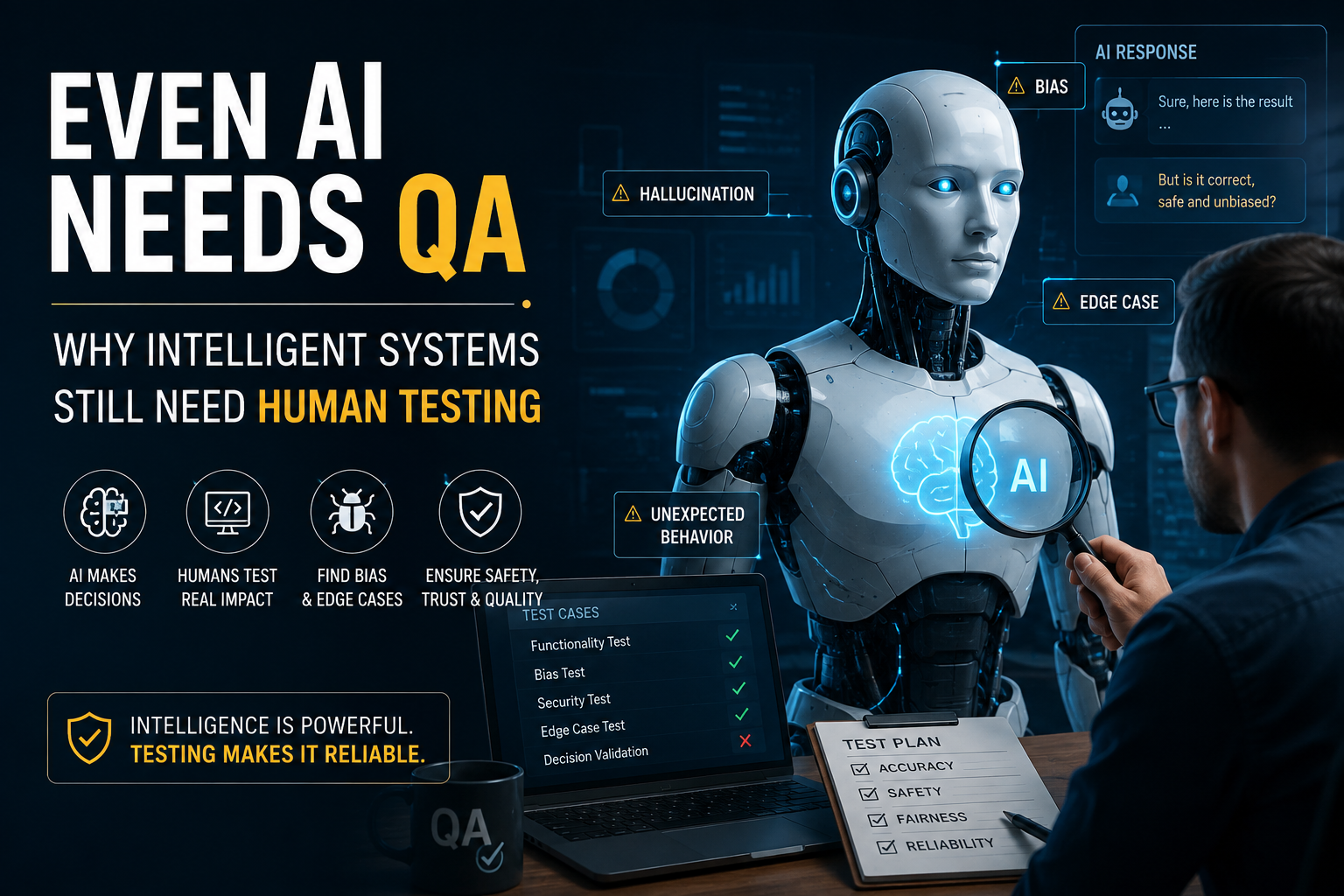
Key Takeaways
- AI can automate and predict, but it can't question itself, human-led QA defines and defends 'correct'.
- Minimum viable AI QA: a golden dataset, prompt regression, grounding checks, and format contracts.
- If you can't name your AI feature's accuracy number today, that's finding #1.
Artificial Intelligence has revolutionized the way we build software, interact with users, and make business decisions. But here's the truth: even the most intelligent AI needs a second opinion, and that's where QA comes in.
AI can automate, predict, and optimize. It can't think like a real user, test emotional intelligence, or anticipate every real-world scenario. As impressive as AI is, its value depends on how well it's tested, validated, and trusted.
At QA Tech Xperts Pvt Ltd, we believe AI may be smart, but its value depends on disciplined execution. That's why we make sure your product ships reliable, secure, and scalable, with an experience users actually enjoy.
What AI Can't Do (But QA Can)
AI systems depend on models, algorithms, and vast datasets. Without rigorous QA, even the most promising AI solution falls short. Human-led QA can:
- Understand real user behavior and emotional context.
- Detect pattern-breaking bugs that models miss.
- Ensure compliance, security, and consistent performance across platforms.
- Validate edge cases that machine logic may ignore.
“AI is only as smart as its QA.”
Four Flexible Ways to Engage
Hiring, training, and maintaining an in-house QA team isn't always practical, especially when you're scaling fast. Every company, product, and timeline is different, so we offer four models:
- On-Demand Testing: Urgent needs, testers deployed within hours.
- Project-Based QA: Full-cycle QA for specific projects, platforms, or milestones.
- Dedicated QA Teams: Engineers trained on your product, working as an extension of your team.
- Managed Testing Services: End-to-end QA management, planning, execution, reporting, and optimization.
Where We Make an Impact
We work across OTT and streaming, SaaS, E-commerce, consumer platforms, utilities and energy, healthcare and travel, on mobile and web applications and on AI/ML systems. Where a sector is outside that list we say so rather than implying a track record we do not have.
How to Actually Test an AI Feature
'Human-led QA for AI' is concrete work, not philosophy. This is the minimum practice we stand up for any LLM-powered feature before it faces users:
- Golden dataset first: 50–200 real inputs with agreed-correct outputs. Without it, every evaluation is an opinion.
- Prompt regression suite: every prompt change runs the battery; a wording tweak that fixes one behavior can silently break ten others.
- Grounding checks: every factual claim in a RAG answer must trace to a retrieved chunk, an unsupported claim is a hallucination even when it happens to be true.
- Schema and format contracts: validate structured outputs on every response, in test and production, with alerting on parse-repair rates.
- Failure-mode injection: feed the feature ambiguous, adversarial, and out-of-scope inputs; the correct answer to a question outside its knowledge is a refusal, not an improvisation.
- Tone and safety battery: the same 30 prompts scored across model versions, so an upgrade can't quietly change your product's voice.
A Starter AI QA Checklist
- Can you name the accuracy number for your AI feature today? If not, that's finding #1.
- Does a prompt change require any test to pass before deploy?
- Do you know your hallucination rate per release, or only per incident?
- Is there a hard rule for what the feature does when it doesn't know?
- Has anyone adversarially attacked it (prompt injection, jailbreaks) before real users do?
- When the model provider ships an upgrade, what breaks silently, and would you notice?
Using AI vs. Testing AI, Keep the Two Jobs Straight
Two different conversations hide under 'AI and QA.' One: using AI inside QA tooling, self-healing selectors, generated test drafts, predictive prioritization. Valuable, and still tooling: it needs the same skeptical validation as any test infrastructure, because a self-healing selector that 'heals' onto the wrong button fails silently by design. Two: Testing AI features your product ships, a genuinely new discipline with its own methods (golden datasets, evals, grounding checks). Teams that conflate the two buy an AI Testing platform and believe their chatbot is now tested. It isn't; nobody has even measured it.
A Failure Pattern From the Field
The shape we see repeatedly: a support chatbot retrieves the right document, writes a fluent and friendly answer, and states the wrong policy, because the retrieved passage covered the general case and the user asked about the exception. No error was thrown, the customer was politely misinformed, and the team found out from a complaint, not a dashboard. Every layer 'worked.' What was missing is exactly what human-led AI QA installs: a grounding check that asks 'does the answer's claim actually appear in the retrieved context?', a question no amount of model intelligence asks about itself.
FAQ: Can AI test itself?
Partially, and never sufficiently. LLM judges scoring LLM outputs are useful scale tools, and we use them daily. But a judge model shares failure modes with the model it judges, so the judge needs its own spot-check audit against human labels. The uncomfortable rule: somewhere in the loop, a human must own the definition of correct, or the whole evaluation tower is built on sand.
FAQ: What skills should QA teams add for the AI era?
Three, in order: dataset thinking (building and maintaining golden datasets is the new test-case design), basic Python (the eval ecosystem, promptfoo, DeepEval, Ragas, lives there), and statistical literacy (AI quality is distributions and thresholds, not pass/fail). Manual Testing instincts transfer beautifully, exploratory Testing of an AI feature is adversarial prompting with a better name.
The Human + Automation Advantage
We combine human intuition with Automation to ensure every release is your best release.
AI may evolve and adapt, but it can't question itself. Human-led QA ensures your tech delivers value, not just predictions. Whether you're building an app, scaling an AI solution, or managing a product ecosystem, we're here to make sure your software is ready for real users.
Website: www.qatechxperts.com · Email: info@qatechxperts.com · Phone: +91 92667 88625
Because at the end of the day, users remember experiences, not algorithms.
Want us to run this on your product?
A free 30-minute assessment. We'll tell you what's working, what's costing you time, and where to start. Findings delivered within days.
Get a Free QA Assessment