



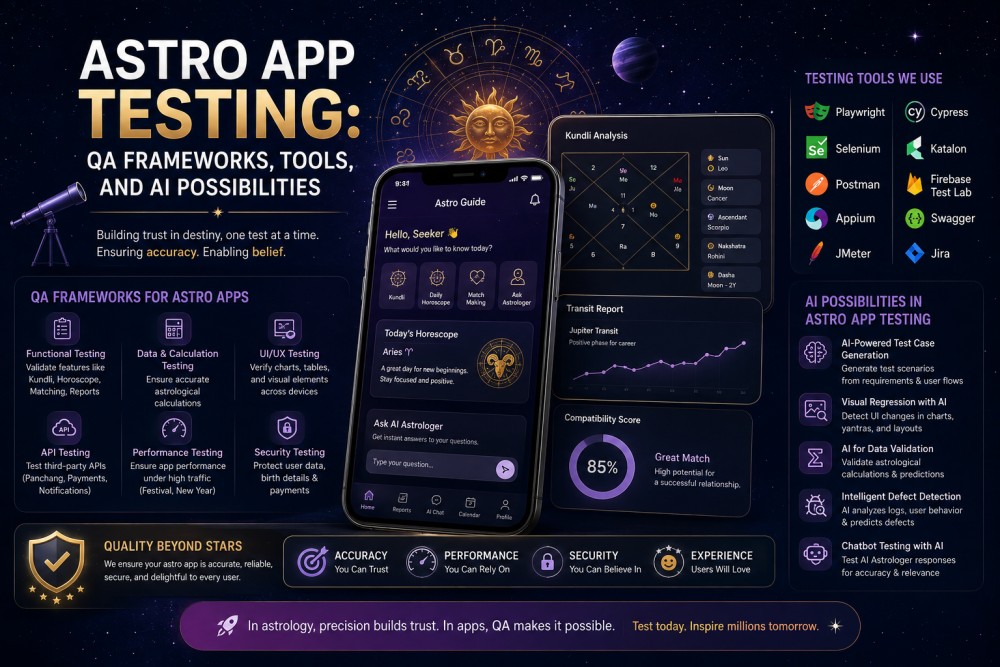
Key Takeaways
- Astro apps are trust-based systems: one wrong planetary position erodes retention faster than any UI bug.
- Validate the astro engine against reference ephemeris data (JPL, Swiss Ephemeris) on every release.
- AI-generated readings need eval harnesses for grounding, tone, and cultural sensitivity, not spot checks.
Astro App Testing: QA Frameworks, Tools, and AI Possibilities
Astrology applications today are complex ecosystems that combine astronomy data pipelines, astrological logic engines, real-time user services, AI-driven personalization, and secure commerce flows. Unlike standard apps, Astro apps are trust-based systems, where precision, cultural alignment, and ethical AI outputs directly impact user experience and retention.
Testing these platforms requires holistic QA engineering covering functional correctness, performance scalability, security resilience, AI/ML validation, compliance, and cross-cultural UX Testing.
System Architecture of an Astro App
Layers:
Frontend (iOS, Android, Web): Horoscope views, kundli chart renderers, daily notifications, astrologer consultations. QA focus: UI responsiveness, cross-device compatibility, accessibility.
Backend APIs: GraphQL/REST APIs for planetary data, matchmaking logic, calendar synchronization. QA focus: API accuracy, schema validation, error handling, response latency.
Astro Engine: Core computation module: planetary position algorithms, dasha/mahadasa, guna-milan calculators. QA focus: Algorithm validation, rule correctness, time-zone accuracy.
Third-Party Integrations: Ephemeris APIs (NASA JPL, Swiss Ephemeris), Payment Gateways, Video/Chat APIs. QA focus: Integration resilience, API versioning, fallback handling.
AI/ML Modules: NLP-based chatbots, personalized prediction engines, recommendation systems. QA focus: Accuracy, model drift, bias detection, explainability.
Data Layer: Stores user PII, birth details, chat transcripts, payment logs. QA focus: Database consistency, encryption, GDPR/CCPA compliance.
Functional Testing in Astro Apps
Functional correctness is non-negotiable, a single wrong planetary placement or chart calculation erodes trust.
Ephemeris Validation: Compare astro engine planetary calculations against reference datasets. Tools: Python Astronomy Libs, Swiss Ephemeris API, NASA JPL API.
Astrological Logic: Validate Guna Milan scoring, zodiac assignments, dasha timelines. Tools: JUnit/TestNG, PyTest, Mocha/Chai.
Calendar/Time Zones: Leap years, DST, Julian vs Gregorian calendars. Tools: Moment.js, Joda-Time.
Consultation Modules: Video (WebRTC), real-time chat, astrologer availability sync. Tools: TestRTC, WebSocket Testers, BrowserStack Live.
Non-Functional Testing
Performance & Scalability: festival-day traffic spikes, stress tests, and SLA benchmarking. Tools: JMeter, Locust, k6, Gatling.
Security: Encrypt PII, PCI-DSS for payments, OWASP Top 10 validation. Tools: OWASP ZAP, Burp Suite, Nessus, Veracode.
UX & Accessibility: Multi-language (Hindi, Tamil, Arabic, Chinese), dark mode, WCAG compliance. Tools: Applitools Visual AI, Axe, Lighthouse, NVDA/JAWS.
AI & ML Testing in Astro Apps
AI Horoscope Generation: Cross-check ML vs deterministic logic, detect bias/drift. Tools: MLFlow, TensorFlow Model Analysis, Explainable AI dashboards.
Chatbots: Validate NLP intents, cultural bias checks. Tools: Rasa Test, Botium, Dialogflow Test Suite.
AI Testing Possibilities: Self-healing tests, predictive QA, AI visual Testing. Tools: TestRigor, Functionize, Applitools Eyes, Mabl.
Advanced Test Case Examples
- Ephemeris Accuracy Test: Jupiter’s position (5 Nov 2025, 14:35 IST) must match NASA JPL Horizons within ±0.1°.
- Leap Year Validation: Kundli for 29 Feb 2000 valid across IST/PST/GMT.
- API Load Test: 500K horoscope API calls in 30 minutes, SLA p95 < 500ms.
- Chatbot Query: “Will I get married in 2026?” must give astrological context.
- Security Test: Simulate SQL injection on DOB input, verify system rejects.
How QA Tech Xperts Can Help
QA Tech Xperts Pvt. Ltd. delivers end-to-end QA for astrology apps, ensuring accuracy, security, and scalability.
Engagement models: short pilots or dedicated QA pods, scoped to your product and timeline. Contact QA Tech Xperts to schedule a call.
- Functional & Non-Functional Testing – Kundli validation, APIs, performance, security.
- Automation – UI/API regression with Playwright, Cypress, Selenium.
- AI Validation – Chatbot accuracy, bias checks, ML drift monitoring.
- Performance & Security – JMeter/k6 load, OWASP penetration Testing.
- Accessibility & UX – WCAG compliance, multi-language, Applitools regression.
A Test Pyramid for Astro Apps
Astro platforms reward a classic pyramid with two extra layers. At the base, unit tests on the astro engine: planetary math, dasha calculations, and matchmaking scores are pure functions, cheap to test exhaustively. Above that, API contract tests on chart and prediction endpoints; then a thin E2E layer on the money paths (chart generation, consultation booking, payment). The two extra layers are data validation against reference ephemeris sources, and AI evaluation for anything an LLM generates.
- Base: deterministic astro-math unit tests, thousands of cases, milliseconds each.
- Middle: API contracts for chart, horoscope, and matchmaking services.
- Top: a dozen E2E journeys covering signup, chart, consultation, payment.
- Side rail 1: nightly reference-data validation against Swiss Ephemeris/JPL.
- Side rail 2: LLM eval suite for AI-generated readings, grounding, tone, and cultural-sensitivity checks.
Example: Ephemeris Accuracy as a pytest Check
Reference-data validation doesn't need a platform, one parametrized pytest against known-good positions catches an engine regression the night it ships:
import pytest
from astro_engine import planet_longitude

# illustrative values, pull real ones from JPL Horizons for your date
REFERENCE = [
 ("jupiter", 95.21),
 ("saturn", 341.78),
 ("mars", 210.44),
]

@pytest.mark.parametrize("planet,expected", REFERENCE)
def test_engine_matches_jpl(planet, expected):
 got = planet_longitude(planet, "2025-11-05T14:35:00+05:30")
 assert abs(got - expected) <= 0.1, (
 f"{planet} drifted {abs(got - expected):.3f}° from JPL reference"
 )
FAQ: How do you test the quality of AI-generated readings?
Three layers: grounding (statements about planetary positions must match the computed chart, the astrology may be interpretive, the astronomy is not), tone and cultural-sensitivity batteries scored across model versions, and ethical guardrails verified adversarially, health, financial, and crisis-adjacent prompts must produce careful, referral-oriented responses every single time, because a trust-based product is one harmful answer away from a headline.
FAQ: Which platforms matter most for an astro app?
Mobile-first is non-negotiable, the usage pattern is a morning daily-check habit on mid-range Android and iOS devices, which makes low-end Android performance and notification reliability Tier-1 test concerns. Web matters for acquisition and long-form content; WhatsApp-style channels matter in several markets. Device-matrix priorities should follow your analytics, exactly as in any consumer product, but weight notification delivery highly, because the daily horoscope that arrives late is a churn event.
Final Word
Astro apps blend astronomy, algorithms, AI, and sensitive user data. Testing them isn’t just about catching UI bugs, it’s about ensuring mathematical precision, ethical AI, resilient systems, and scalability.
Want us to run this on your product?
A free 30-minute assessment. We'll tell you what's working, what's costing you time, and where to start. Findings delivered within days.
Get a Free QA Assessment