



Key Takeaways
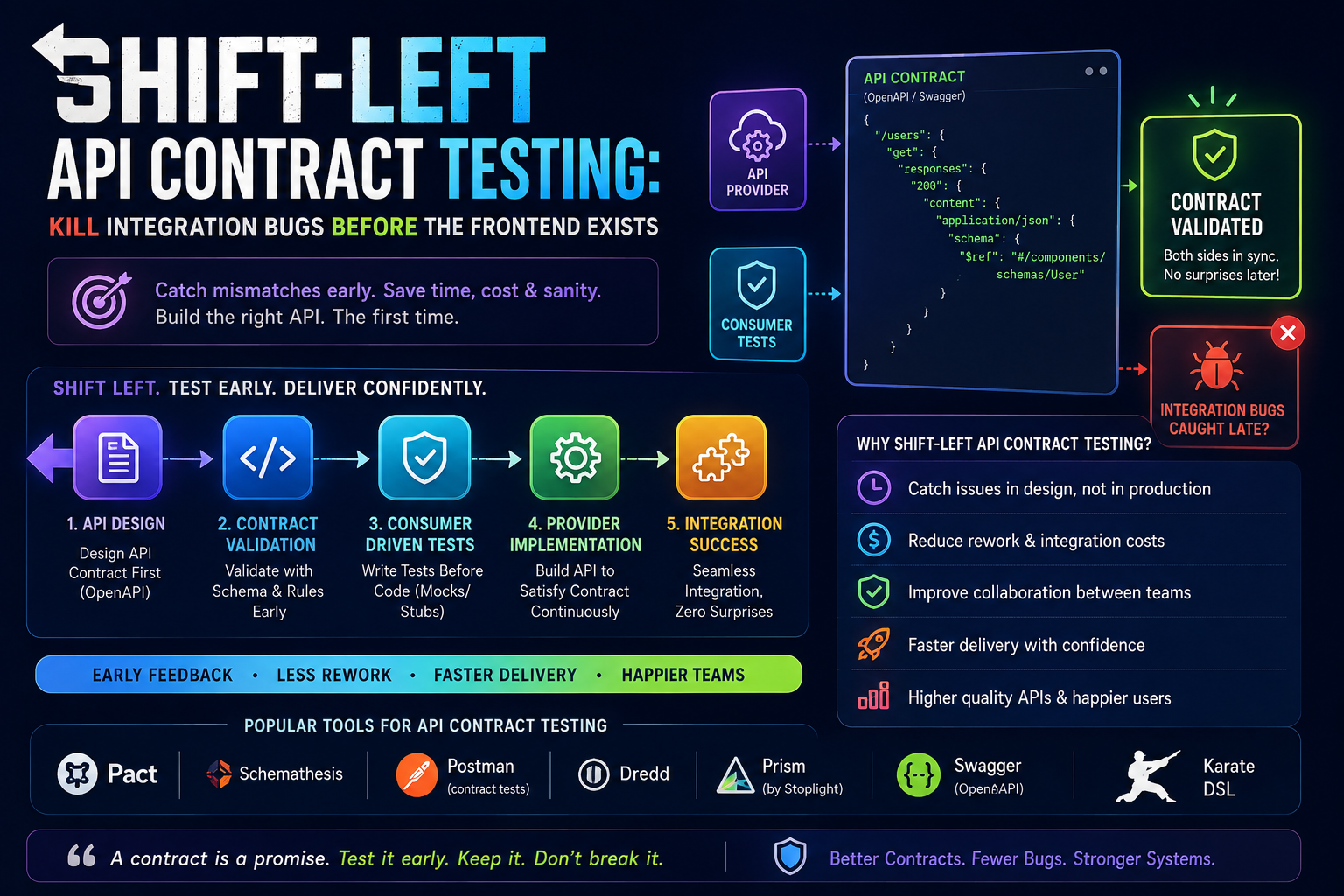
- The schema is the contract: version it in git, review it like code, validate every response against it in CI.
- Consumer tests make removing a field fail the provider's build, not production.
- Teams with contract gates stop having integration phases; frontends build against mocks that are guaranteed accurate.
API contract Testing verifies that provider and consumer agree on the shape, types, and semantics of every payload, automatically, in CI, before integration. It replaces the most expensive bug class in multi-team Development: the mismatch discovered during integration week.
The practical setup
- Schema-first: the OpenAPI/GraphQL schema is the contract, versioned in git, reviewed like code
- Provider tests: every endpoint response validated against the schema on every merge
- Consumer tests: frontend and service consumers pin the fields they actually use, so removing a field fails the provider's build, not production
- Breaking-change gate: CI diffs the schema and blocks incompatible changes without a version bump
Why this converts to speed
Teams adopting contract gates typically stop having 'integration phases' at all, frontends build against generated mocks that are guaranteed accurate. The QA win is invisible: entire categories of bugs stop existing.
A minimal contract in practice
A contract doesn't have to be elaborate to pay off. Here's the shape of a provider check that runs on every merge, the schema is the source of truth, and the test simply refuses to let reality drift from it:
# openapi fragment, the contract, versioned in git
paths:
 /orders/{id}:
 get:
 responses:
 "200":
 content:
 application/json:
 schema:
 type: object
 required: [id, status, total]
 properties:
 id: { type: string }
 status: { type: string, enum: [pending, paid, shipped] }
 total: { type: number }
Why integration week keeps happening
Every organization says 'we integrate continuously'; most still have an integration week, it's just distributed into surprise Slack threads. The mechanics are always the same: the API described in the ticket drifts from the API that shipped, the frontend built against the ticket, and the drift is discovered at runtime by a human. Multiply by every consumer of every endpoint and you get the familiar rhythm: mismatch, hotfix, resentment. Contract Testing doesn't ask teams to communicate better, it makes the schema the single source of truth and lets CI do the arguing.
Provider tests and consumer tests do different jobs
Provider tests protect the present: every endpoint's real response validated against the schema on every merge, so the implementation can't drift from the documentation. Consumer tests protect the future: each frontend or service records which fields it actually depends on, and those expectations run in the provider's CI. The payoff shows up the day someone renames a field, the provider's build fails with 'checkout-web depends on this,' and a production incident becomes a five-minute conversation before merge.
A property-based layer on top finds what example-based tests miss. Point Schemathesis at your OpenAPI spec and it generates hundreds of valid and boundary-case requests, hunting for the 500s hiding between your happy-path examples:
# generate and run property-based API tests from the schema
schemathesis run https://api.example.com/openapi.json \
 --checks all \
 --stateful=links \
 --report junit \

# typical first-run findings: unhandled nulls, integer overflows,
# enum values the docs promise but the API rejects
Beyond REST: GraphQL and event contracts
The discipline generalizes. GraphQL schemas are contracts by construction, add breaking-change detection (schema diff in CI) and persisted-query validation, and you have the same gate. Event-driven systems need it even more: a message published to a queue has no HTTP 400 to defend consumers, so schema-registry validation (Avro, Protobuf, JSON Schema) on publish is the only thing standing between a producer refactor and six silent consumer failures. If your architecture has queues and no schema registry, that's finding #1.
The tooling landscape
| Tool | Approach | Best when |
|---|---|---|
| Pact | Consumer-driven contracts | Many internal service consumers |
| Schemathesis | Property Testing from OpenAPI | You want bugs found, not just shapes checked |
| Spectral | Schema linting in CI | Enforcing API design standards early |
| Dredd | Spec-vs-implementation diffing | Legacy APIs gaining their first contract |
| Karate | BDD API suites with schema match | Teams who want contracts inside readable tests |
Rolling it out without a big-bang project
- Week 1: put the schema in git for your two most-integrated services; review changes like code.
- Week 2: add provider validation to CI, every response checked against the schema on merge.
- Week 3: generate mocks from the schema and point one frontend team at them.
- Week 4: turn on the breaking-change diff gate. From here, incompatible changes need a version bump to ship.
- Skip: trying to contract every endpoint at once, coverage follows value, and the payment path is worth ten settings pages.
Monitoring RAG in production
The regression suite guards changes you make; production monitoring catches changes that happen to you, document drift, index corruption, upstream model updates. Three signals with alert thresholds: grounding rate (sampled answers whose claims trace to retrieved chunks, your live hallucination meter), retrieval-set stability (sudden shifts in which chunks serve popular questions flag index problems), and 'I don't know' rate in both directions, dropping means new confident nonsense; spiking means retrieval broke. Sample 5% of traffic through the grounding checker and you have observability most RAG teams only wish for.
Want us to run this on your product?
A free 30-minute assessment. We'll tell you what's working, what's costing you time, and where to start. Findings delivered within days.
Get a Free QA Assessment